
Paralympics Tokyo 2020 Dreams Shattered
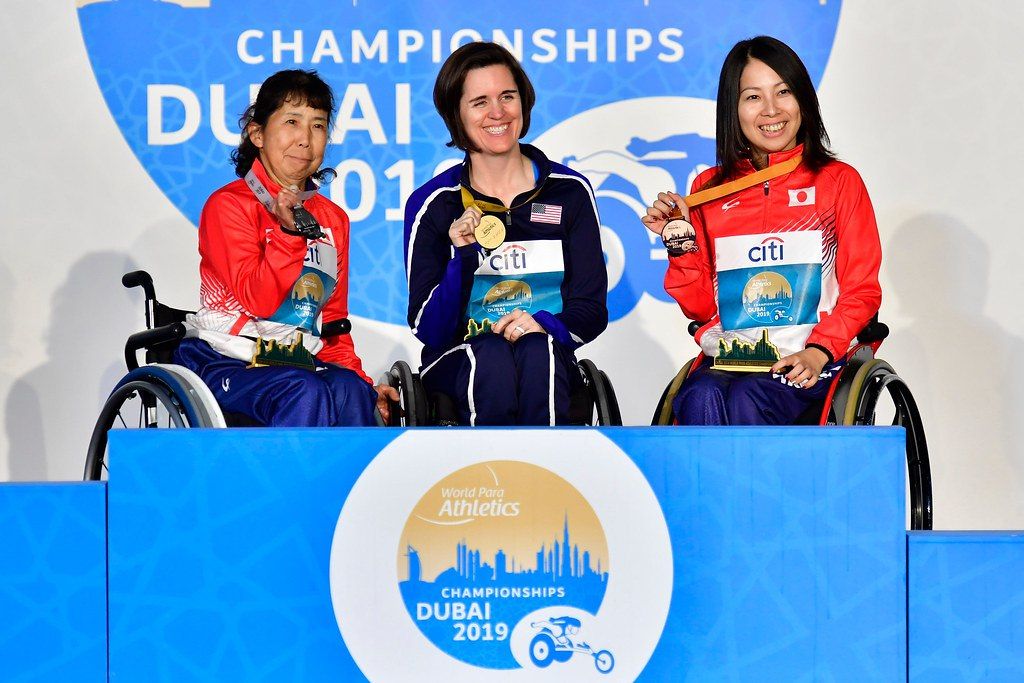
From left-to-right: Teruyo Tanaka (JPN), Kerry Morgan (USA) and Yuka Kiyama (JPN) | © IPC
Imagine dedicating years of hard work to reach the pinnacle of your sporting career, such as the Paralympic Games. Just as you are preparing to compete and realise your goal of representing your country at the highest level, you are suddenly informed that your event has been removed. Through no fault of your own, your lifelong dream is abruptly taken away.
On 5 December 2019, the International Paralympic Committee (IPC) announced that the women’s T52 100 metres event had been removed from the Tokyo 2020 Paralympic Games. The IPC informed the Tokyo Organising Committee and National Paralympic Committees (NPCs) of this decision after determining that the event did not meet the minimum eligibility criteria.
NPCs were also advised that any events failing to meet the required standards by the end of the 2019 World Para Athletics Championships would be excluded from the Tokyo 2020 medal programme, without replacement events being added. In the women’s T52 100m at the Dubai World Championships, only five athletes from four NPCs took part, falling short of the required participation level.
To be fair to all five athletes who competed at the Para Athletics World Championships in Dubai, let us first examine how this situation unfolded as we sought answers on what went wrong and how it should have been handled.
Ways To Qualify
Athletes in Para Athletics can qualify for the Paralympic Games through several routes, as set out by the IPC in the following order:
- 2019 Marathon World Championships allocation (London, Great Britain)
- 2019 World Championships allocation (Dubai, United Arab Emirates)
- Qualification ranking allocation
- Representation allocation
- 2020 World Para Athletics Marathon World Cup (to be confirmed)
- High-performance allocation
- Bipartite Commission invitation allocation
The Qualification Regulation
The following excerpt is taken from the Tokyo 2020 Paralympic Games Qualification Regulations for Athletics. It highlights two of the seven qualification methods, focusing specifically on direct slot allocations, which are most relevant to this topic.
QUALIFICATION SYSTEM
Qualification slots will be allocated as follow:
The top four (4) ranked athletes at the 2019 World Para Athletics Championships in each of the Individual medal events on the Tokyo 2020 Paralympic Programme (excluding Marathon) will each obtain one (1) qualification slot for their respective NPC.
In the case that an athlete is ranked first to fourth in more than one medal event, the athlete can only obtain one (1) qualification slot for their NPC.
Athletes who have obtained a qualification slot at the 2019 World Para Athletics Marathon World Championships cannot obtain an additional slot for their NPC through this allocation method or vice versa.
In the case that fewer slots are allocated through this method than available in the quota, World Para Athletics will allocate the remaining slots via the Qualification Ranking Allocation method…
World Para Athletics will establish a 12-month Qualification Ranking from 1 April 2019 to 1 April 2020 for each of the Individual medal events on the Tokyo 2020 Event Programme except for the Marathon medal events.
The Qualification Ranking will only recognise athletes who were licensed at the time they achieved the result in accordance with the IPC Athlete Licensing Programme Policies valid for the 2019-2020 seasons and who hold an international sport class status of ‘Review’ or ‘Confirmed’ prior to 1 April 2020.
The top six (6) ranked athletes of each Individual medal event will obtain one (1) qualification slot for their respective NPC. In the case that an athlete is eligible in more than one (1) medal event for slot allocation under this method, he/she can only obtain one (1) qualification slot for his/her NPC.
Athletes who have obtained a qualification slot through the aforementioned methods cannot obtain an additional slot for their NPC through this allocation method.
In the case that fewer slots are allocated through this method than available in the quota, World Para Athletics will allocate the remaining slots via the Representation Allocation method…
From the excerpts above, it is clear that athletes at the Para Athletics World Championships in Dubai were to be allocated qualification slots via the 2019 World Championships Allocation (Dubai, UAE), rather than the Qualification Ranking Allocation. However, as only five athletes from four nations participated, the IPC determined that the minimum eligibility criteria were not met.
The Event Viability Criteria
Let’s examine the eligibility criteria and event viability requirements for the 2019 Para Athletics World Championships in Dubai. The following is an excerpt:
A minimum of five (5) athlete entries from three (3) NPCs is necessary to sustain an individual event on the programme. A minimum of five (5) entries from five (5) NPCs is necessary to sustain the relay medal event on the programme.
World Para Athletics shall review the event viability following the close of the final name on 01 October 2019. In the case an event did not meet the above viability criteria by final entry, World Para Athletics reserve the right to combine such event with other event(s) where appropriate and applicable. In such combined field events, the Raza point system may be used to determine the placings.
World Para Athletics also reserve the right to either cancel such events or run them as non-medal events.
In the case the entry number of an event dropped below the aforementioned event viability criteria due to withdrawals after 01 October 2019, the event shall still be run as a Medal Event and the medals will be allocated under the “minus one” rule.
Conclusion for Viability
From the excerpts above, it is clear that for an event to be considered viable, it must have at least five (5) athletes from three (3) nations. An exception appears to apply to relay medal events, which may require at least five (5) athletes from five (5) nations. Beyond this, the criteria are not clearly defined, which creates potential ambiguity.
If the viability requirements are applied consistently, then an event deemed viable at the Para Athletics World Championships in Dubai should also be considered viable for the Tokyo 2020 Paralympic Games programme. At the time of writing, no additional specific criteria could be identified in the available sources.
The Impact
The Facts
Any Solution?
That said, there remains a possibility to save the T52 Women’s event through a Bipartite Commission Invitation Allocation, provided there is full agreement and it is done within the remaining time available.
Seven (7) eligible male athletes and seven (7) eligible female athletes will be considered by IPC and World Para Athletics for Bipartite Commission Invitation qualification slots. Some or all of these slots may be used to protect the viability of certain medal events.
To be considered for a Bipartite Commission Invitation slot, NPCs must submit an official application in writing to World Para Athletics by 1 June 2020.
As a Paralympic value, equality is reflected through sport: Para athletes celebrate diversity and demonstrate that difference is a strength. As pioneers of inclusion, they challenge stereotypes, shift attitudes, and help break down social barriers and discrimination against persons with disabilities.
Isn’t it striking that this message of equality still needs to be “proven” in the first place?
Author:
Jason J. Red – an observer in disability sports development and Paralympic movement. Occasionally writes for WRAS for local sports development and general awareness.